
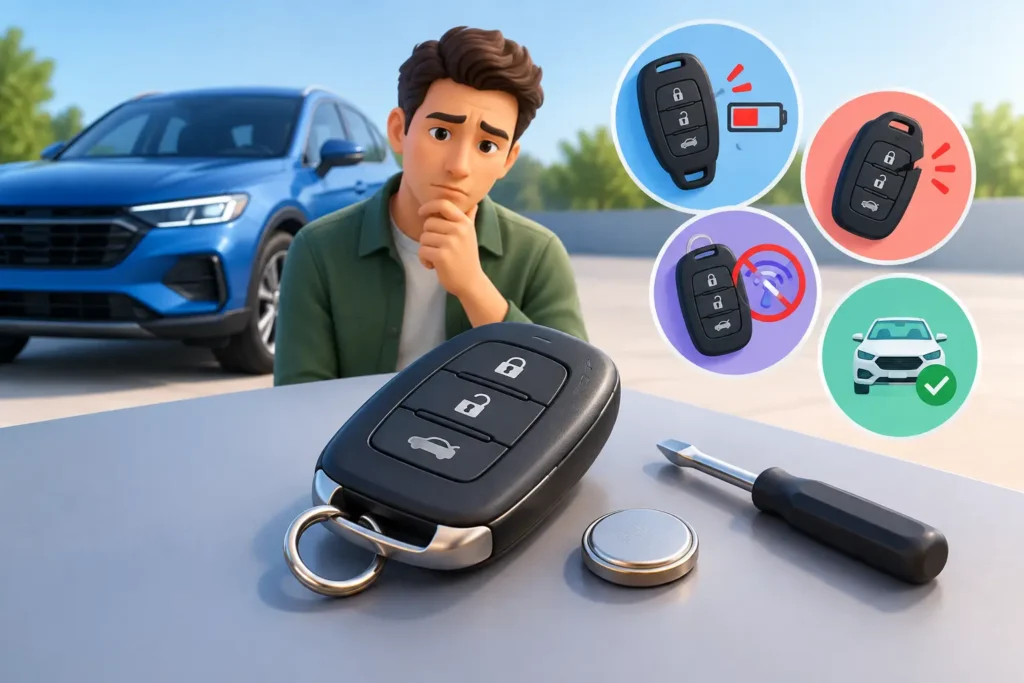
A key fob can fail at the worst possible moment: outside work after a late shift, on the drive during the school run, or at a fuel station when you need to be somewhere else. Don’t panic. A fob that will not lock, unlock or start your car does not always mean an expensive main-dealer visit. In many cases, the fault can be identified and resolved at your location by an automotive locksmith with the right diagnostic and programming equipment.
The useful first step is to work out whether you have a simple remote-control problem, a damaged key, or an immobiliser issue stopping the vehicle from starting. That distinction affects what can safely be tried at home and when it is time to call for assistance.
What does a key fob actually do?
Most modern vehicle keys do more than open the doors. Your key fob may contain a remote circuit board for central locking, a transponder chip recognised by the immobiliser, a battery, and a metal emergency blade. Smart keys may also communicate with the vehicle wirelessly, allowing keyless entry and push-button starting.
These parts can fail separately. For example, a flat battery may stop the remote buttons working while the transponder still allows the engine to start. Equally, a key can unlock the car with its blade but fail to start it because the immobiliser chip is missing, damaged or no longer recognised.
That is why replacing a battery is not always the answer, and why forcing a casing open or trying online programming tricks can turn a repairable problem into a replacement-key job.
The most common key fob faults
A weak or flat battery is the most familiar cause. Signs include needing to stand very close to the vehicle, intermittent locking, reduced range, or a dashboard message warning that the key battery is low. If you have a spare fob, test it. When the spare works normally, the problem is usually isolated to the first key rather than the car.
Physical damage is another frequent issue. Keys are dropped, sat on, exposed to rain, put through washing machines and worn down by years on a crowded keyring. A cracked casing can let moisture reach the circuit board. Worn buttons may no longer press the internal switches properly, while a loose battery contact can make the fob work only occasionally.
There are also faults inside the vehicle. A weak car battery, blown fuse, receiver fault or central-locking issue can make a perfectly healthy remote appear faulty. If neither of your keys operates the locks, particularly after the vehicle battery has gone flat, the vehicle itself needs checking as well as the fobs.
Finally, the car may not recognise the key’s transponder or smart-key signal. You may see an immobiliser warning light, a message such as “key not detected”, or an engine that turns over but will not start. This is where specialist diagnostics and correct programming matter.
Safe checks to make before calling for help
Start with the simple checks, but avoid anything that could damage the key or vehicle. Try the spare key if you have one. Check whether the fob works from close range and whether any buttons feel loose, sticky or unresponsive.
If the car has an emergency mechanical key blade, use it carefully to gain entry if the remote has stopped working. Some vehicles trigger the alarm when opened this way. That can be normal. Follow the vehicle handbook’s emergency-start procedure where available, often by holding the fob against a marked area or close to the start button.
For a straightforward battery change, use the exact battery type specified for your fob and fit it the correct way round. Work over a clean surface and do not lever aggressively against the circuit board. If the casing is split, the key has been wet, or the board is visibly damaged, stop there. A repair may still be possible, but further handling can cause more damage.
Do not tape a loose transponder chip inside the casing and assume it is secure. On some keys, that small chip is the difference between an engine that starts and one that remains immobilised. It needs to be retained, positioned correctly or replaced and programmed by a professional.
When the problem is more than a flat battery
Call an automotive locksmith when you are locked out, the vehicle will not start, the only key is lost, or the fob is physically broken. A mobile technician can usually establish whether the key is transmitting, whether the immobiliser is recognising it, and whether a replacement or repair is the sensible route.
A replacement key fob is not simply a piece of plastic with buttons. It normally needs the correct blade cut, the remote functions programmed and the transponder or smart-key system paired to the car. The exact process depends on the make, model and year. Some vehicles require security information and manufacturer-approved procedures, while others can be programmed directly using specialist diagnostic equipment.
This is also why prices vary. A basic remote repair or battery replacement is very different from supplying and programming a proximity smart key for a newer vehicle. The best approach is upfront pricing based on your registration, vehicle details and the fault, rather than guessing before the key system has been assessed.
Repair, replacement or spare key?
If the board and immobiliser chip are sound, a damaged casing or worn buttons may be repaired. This can be a practical option when the fob has been dropped but still starts the car. Rehousing the key in a quality replacement casing protects the electronics and can restore normal button operation without replacing the whole key.
Replacement is usually needed when the electronics have failed, the transponder chip is lost, water damage has corroded the board, or the key is beyond economical repair. A mobile automotive locksmith can cut and programme a new key at your home, workplace or roadside location, removing the need to arrange transport to a dealer in many situations.
If your current key still works, a spare is often the least stressful choice. It is easier and usually less disruptive to create a second working key before the original is lost or damaged. For families sharing a car, tradespeople carrying equipment, delivery drivers and anyone commuting across South Yorkshire, that spare can prevent a small mishap becoming a missed day of work.
Lost key fob? Protect the vehicle as well as your day
A lost key creates two problems: you need another way into and away in the car, and you need to consider who may find the missing key. If your keys were lost with documents showing your address, or you believe they may have been stolen, tell the locksmith.
Depending on the vehicle, it may be possible to erase the lost key from the vehicle memory while programming new keys. That means the old fob should no longer start the car, even if it turns up in the wrong hands. It is a sensible security step, particularly for keyless vehicles.
Have your vehicle registration, make, model and location ready when you call. Proof of ownership may also be required before new keys are supplied or security work is carried out. These checks protect you and help the technician arrive prepared with suitable stock and equipment.
Avoiding future key fob trouble
Keep the fob dry, avoid overloading it with heavy keys, and replace the battery when range begins to fall rather than waiting for total failure. Store your spare somewhere safe at home, not inside the vehicle. If the casing starts to crack or the blade becomes loose, arrange a repair early.
For keyless entry vehicles, consider where you keep the fob at night. Keeping it away from external doors and using suitable signal protection can reduce the risk of relay theft. It will not prevent every form of vehicle crime, but sensible storage is a worthwhile precaution.
If you are in Doncaster, Goole, Thorne, Selby or the wider South Yorkshire area and your key has stopped cooperating, do not keep trying to force it. A calm assessment, the right equipment and a properly programmed key can get you moving again without adding avoidable damage to the problem.
Pingback: What to Do When You Need Broken Key Extraction - Prestige Auto Locksmith Doncaster