
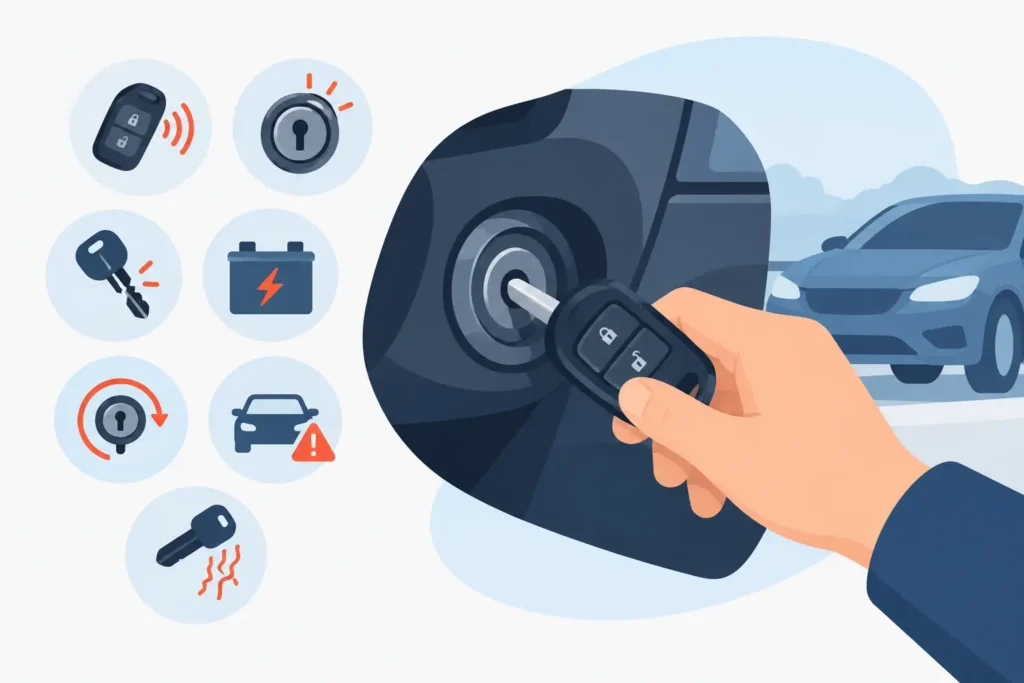
A key that needs a wiggle before the engine starts is easy to dismiss when you are late for work. But it is often one of the earliest signs of failing ignition keys. Leave it long enough and a minor fault can turn into a key stuck in the ignition, an immobiliser that will not recognise the key, or a vehicle that will not start outside your home, workplace or on the roadside.
Modern vehicle keys do far more than turn a lock. Many contain a precision-cut blade, a transponder chip, remote-fob buttons, a battery and electronic components that communicate with the car’s immobiliser. A fault in any one of these areas can stop you getting moving. The good news is that many failures give a warning first.
1. The key is difficult to insert or turn
A healthy key should slide into the ignition and turn with light, consistent pressure. If it catches, feels tight, or only turns after several attempts, do not force it. The blade may be worn, bent or damaged, particularly if the key has spent years on a heavy keyring or has been dropped.
There is a trade-off here: the issue could also be the ignition barrel rather than the key. A quick comparison with a working spare key is useful. If the spare turns smoothly, your usual key is the likely cause. If both keys feel stiff, the barrel may need attention instead.
Forcing a reluctant key risks snapping it inside the ignition. Broken-key extraction is possible, but it is far simpler and usually less disruptive to deal with a worn key before it breaks.
2. The engine starts only after repeated attempts
If the key turns but the engine does not start straight away, the problem may be electronic rather than mechanical. Most modern cars use a transponder chip inside the key. When you turn the ignition or press the start button, the vehicle checks that chip before allowing the engine to run.
An intermittent immobiliser warning light, a brief start followed by an immediate stall, or a message saying that no key has been detected can all point to a failing transponder or a programming issue. The fault can seem random at first, which is why drivers often assume the car battery is to blame.
Try your spare key if you have one. When the spare works reliably and the main key does not, avoid relying on the faulty key. A mobile automotive locksmith can test the key, read relevant vehicle fault information, cut a replacement where needed and programme it to the vehicle on site.
3. The key casing is cracked, loose or held together with tape
A cracked key fob is not simply a cosmetic annoyance. Inside the casing sit small components that can move out of position after a drop or repeated pressure. The transponder chip may become loose, the button contacts can fail, and moisture can reach the circuit board.
Some drivers transfer the blade or electronics into a cheap replacement shell. That can work on certain key types, but it is not always straightforward. A transponder chip can be very small and easy to lose or damage. If it is not transferred correctly, the remote may work while the vehicle still refuses to start.
If your key casing is splitting, the buttons are sinking into the shell, or the blade moves in a folding key, arrange a proper repair before the key comes apart in your hand. A casing repair can preserve working electronics and save you from a full replacement where appropriate.
4. Remote buttons work only occasionally
Remote locking faults are another common sign that a key is nearing failure, although they do not always affect the ignition function. You may need to stand closer to the vehicle, press the button repeatedly, or find that one button works while another does not.
Start with the simple possibility: a depleted fob battery. Batteries are inexpensive, but fitting the wrong type, fitting it the wrong way round or damaging the casing clips can create a new problem. If a fresh, correctly fitted battery makes no difference, the issue could be worn button contacts, a damaged circuit board or a key that has lost synchronisation.
Do not assume a remote fault can be ignored because the key still starts the car. It may leave you unable to lock the vehicle securely, and it is often evidence that the key has suffered wear or water damage.
5. The key has been dropped, washed or exposed to moisture
Keys are tougher than they look, but they are not waterproof. A key dropped into a puddle, left in wet clothing, or sent through a washing machine can develop faults days or weeks later as corrosion affects the internal electronics.
Likewise, a hard drop onto concrete can crack solder joints or dislodge the transponder chip without leaving obvious external damage. If the key has had a serious knock or soaking, test every function while you still have a working alternative: lock, unlock, boot release where fitted, ignition operation and keyless entry.
Avoid drying a wet key with high heat. A radiator, hairdryer or oven may warp the plastic casing or damage components further. Remove the battery if you can do so safely, let the key dry at room temperature, and seek help if its operation becomes unreliable.
6. The vehicle displays a key or immobiliser warning
A dashboard key symbol, immobiliser light or warning message should be taken seriously, especially when it appears alongside starting trouble. Depending on the make and model, the vehicle may fail to crank, start and cut out, or refuse to recognise a proximity key altogether.
The warning does not automatically mean the key is at fault. A weak vehicle battery, antenna issue, ignition switch fault or vehicle-side immobiliser problem can produce similar symptoms. That is why guesswork can become expensive. Replacing batteries and repeatedly attempting to start the car may not solve the underlying issue.
A locksmith with dealer-level diagnostic equipment can help separate a key problem from a vehicle problem. For many makes, replacement and programming can be completed at your location without the delay of booking into a main dealer.
7. Your only working key is showing its age
The most overlooked warning sign is having no backup. If your only key has faded buttons, a loose blade, intermittent remote operation or a history of needing persuasion in the ignition, it is already a risk to your daily routine.
This matters most for commuters, tradespeople, delivery drivers and families who cannot easily lose a day to a non-starting vehicle. Creating a spare while the original still works is normally quicker and gives the locksmith a reliable key to copy and programme from. Once all keys are lost or the only key has failed completely, the work can be more involved.
What to do when your ignition key starts playing up
First, stop using force. Do not twist a stiff key hard, prise open a damaged fob with a screwdriver, or keep trying to start the engine until the battery runs down. If you have a spare, use it briefly as a comparison rather than waiting until the main key fails completely.
Keep the suspect key dry and separate from unnecessary heavy keyrings. Note exactly what happens: does the blade stick, do the buttons fail, does the immobiliser light flash, or does the car start and then stop? Those details help identify the likely fault quickly.
For drivers in Doncaster and across South Yorkshire, Prestige Line LTD can attend at home, at work or at the roadside with mobile key-cutting and programming equipment. Depending on the diagnosis, the practical answer may be a new battery, casing repair, replacement key, transponder programming or safe broken-key extraction. You should receive clear pricing before work begins, not a surprise after you are already stranded.
Do not wait for a complete failure
A failing key rarely chooses a convenient moment. It may work for another month, or it may stop recognising the vehicle on the next school run or early shift. Acting when the first symptoms appear gives you options, protects the ignition from damage and helps keep your vehicle available when you need it most. If the key is becoming unreliable, arrange assistance now and get a dependable spare in place before the small warning becomes a full stop.