
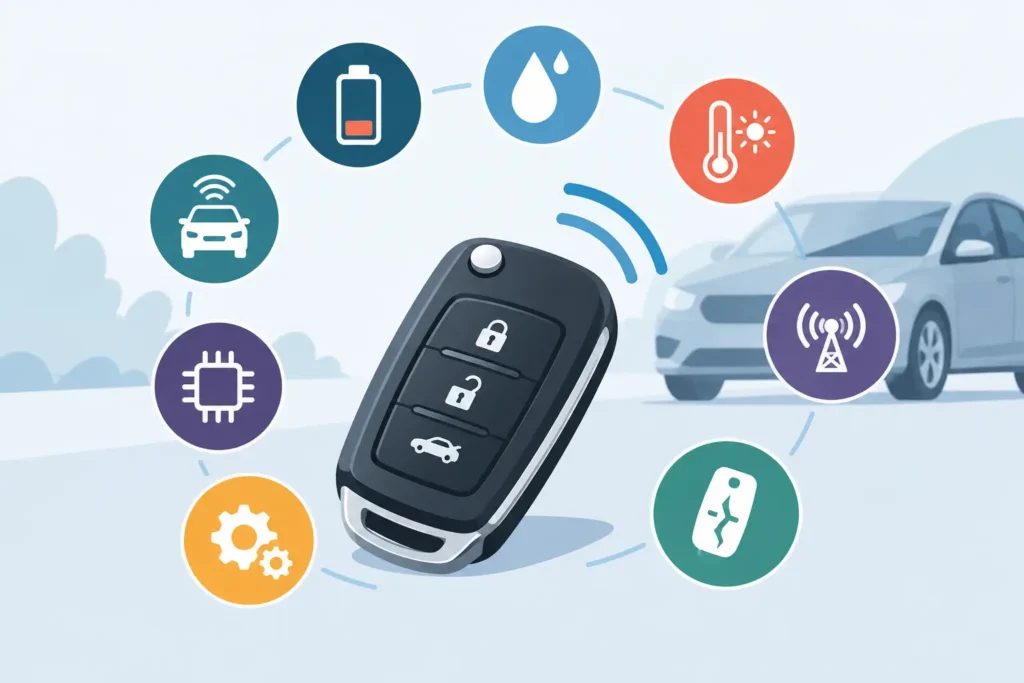
A remote fob that worked perfectly on the school run can suddenly leave you standing outside your car in a supermarket car park, late for work or unable to unload the van. If you are asking, why do car remotes fail, the cause is often straightforward, but the symptoms can be misleading. A fob can fail to lock and unlock while still allowing the engine to start. Equally, a key that looks intact may no longer communicate with the vehicle at all.
Don’t panic or force the lock. Modern vehicle keys combine a battery-powered remote, a transponder chip, a mechanical emergency blade and, on many newer cars, a proximity system. Working out which part has failed is the quickest route to getting back on the road safely.
Why do car remotes fail without warning?
Most remote failures are not truly without warning. The signs are usually easy to miss: you may have needed to stand closer to the car, press the button twice, or tried a few different angles before it responded. Then the battery finally runs flat, a worn button stops making contact, or a small internal fault becomes a complete failure.
The right repair depends on the vehicle and the fault. Replacing a battery may solve a simple problem in minutes. If the fob has lost programming, has water damage or contains a failed transponder, it may need diagnostic testing, repair or replacement and programming to the immobiliser.
1. A flat or poorly fitted remote battery
A weak coin-cell battery is the most common reason for reduced remote range or intermittent locking. Cold weather can make a marginal battery seem worse, while a fob left in a drawer for months can go flat even when it has not been used.
If your remote works only when held close to the vehicle, change the battery using the exact type specified for the fob. Check the battery is fitted the correct way round and that the metal contacts are clean and sitting firmly against it. A new battery fitted upside down, or a low-quality replacement cell, can create the same symptoms as the old one.
Be careful opening the case. Some fobs use clips that can crack easily, and others conceal the emergency key or a small seal designed to keep moisture out. If the casing is already loose or damaged, a professional fob repair may be better than repeatedly forcing it open.
2. Worn buttons or damaged internal contacts
Remote buttons receive thousands of presses over a key’s life. The rubber pad can wear through, the small switch beneath it can fail, or the circuit board contacts can become dirty. You may notice one function stops first, such as unlock, while lock and boot release still work.
A split casing can accelerate the damage. It allows dust, pocket fluff and moisture into the fob, and it can leave the circuit board moving every time the key is handled. Replacing the outer case before the board is damaged is often a sensible, lower-cost preventative repair.
3. Water, condensation or accidental washing
Car remotes are not usually waterproof. Rain in a jacket pocket, condensation in a work bag, a spilled drink or a trip through the washing machine can corrode connections on the circuit board. A fob may work immediately after getting wet, then fail days later as corrosion develops.
Do not keep pressing the buttons to test it, and do not use direct heat from a radiator or hairdryer. Heat can distort the casing and damage delicate components. Remove the battery if you can do so without forcing the fob, keep the remote dry, and arrange a proper assessment. In some cases, cleaning and repair can save the original key. In others, replacement is the more reliable option.
4. Drops, crushed casings and broken solder joints
Keys take more punishment than most electronic devices. They are dropped on paving, trapped under bags, knocked against steering columns and occasionally run over. Even when the outside only has a small crack, the impact can loosen a battery contact or break a solder joint on the board.
This fault often appears intermittent. The fob may work after being squeezed or tapped, then stop again. That is a useful clue, but it is not a repair method. Continued pressure can cause further damage to the board or transponder chip.
5. The remote has lost synchronisation or programming
Some vehicles may stop recognising a remote after a flat vehicle battery, incorrect battery replacement, electrical work or an attempted programming procedure. On other models, the remote buttons and the immobiliser system are separate: central locking may fail while the car still starts, or the key may unlock the car mechanically but the engine will not start.
A key that has lost synchronisation is not necessarily beyond repair. However, internet reset instructions are not universal. Using the wrong sequence can waste time and, on certain systems, create additional programming issues. A locksmith with suitable diagnostic equipment can identify whether the fob is transmitting, whether the vehicle is receiving the signal and whether programming is required.
6. A transponder or immobiliser fault
The transponder is a small chip that proves to the vehicle that the correct key is present. On many older keys it does not use the remote battery at all. That means a car can refuse to start even though the remote locks and unlocks normally, or it can start with a flat remote battery when the key is held in the correct position.
If the dashboard shows an immobiliser or key warning light, or the engine turns over but will not fire, avoid repeated start attempts. The issue may be the key, the vehicle’s reader aerial, the immobiliser system or another electrical fault. Testing the key properly prevents paying for a replacement fob when the vehicle is the real source of the problem.
7. Signal interference or a fault in the vehicle
Not every non-responsive fob is faulty. Strong radio interference around certain buildings, equipment or car parks can temporarily block the signal between the remote and vehicle. Try moving the car a short distance if possible, or use the mechanical key to gain entry and test the remote elsewhere.
If both of your remotes stop working at the same time, suspect the vehicle rather than two failed fobs. A weak car battery, blown fuse, damaged central-locking module, receiver fault or wiring issue can prevent the vehicle from responding. A technician can test the keys before recommending a repair, which matters when the apparent problem is on the car itself.
8. An ageing smart key or proximity-key fault
Keyless entry systems are convenient, but they introduce more components. The vehicle must detect the smart key nearby, communicate with it securely and, on some models, read it from a designated backup position when its battery is low.
Symptoms vary. The doors may not unlock when you touch the handle, the car may display “key not detected”, or it may start only when the fob is held against the emergency reader point. Start with the specified battery, then have the key and vehicle system tested if the warning continues. Do not leave a working smart key inside the vehicle while troubleshooting, as it can increase the risk of an accidental lockout.
What to do when your car remote stops working
First, try your spare key if you have one. This quickly helps separate a vehicle fault from a single-key fault. Next, check whether the emergency blade opens the door and whether the vehicle will start using the manufacturer’s backup procedure, if applicable. Keep the fob away from water and avoid prising it apart with screwdrivers or metal blades.
If you are locked out, do not attempt to bend the door frame, use coat hangers or force a window. These methods can damage weather seals, locking mechanisms, airbags and paintwork, leaving a much larger bill than the original key problem. Non-destructive vehicle entry is designed to restore access without creating further faults.
For drivers in Doncaster and across South Yorkshire, Prestige Line LTD can test the remote, replace batteries, repair damaged casings, cut replacement keys and programme compatible fobs at your home, workplace or roadside location. Where security programming is needed, the work should be completed with the correct diagnostic tools and manufacturer security information, not guesswork.
A spare working key is the simplest protection against a stressful remote failure. If your fob has started needing extra presses or its range has noticeably shortened, arrange a check now while you can still drive the vehicle to a convenient place. Acting early is usually quicker, calmer and less disruptive than dealing with a lockout when you need to be somewhere.